
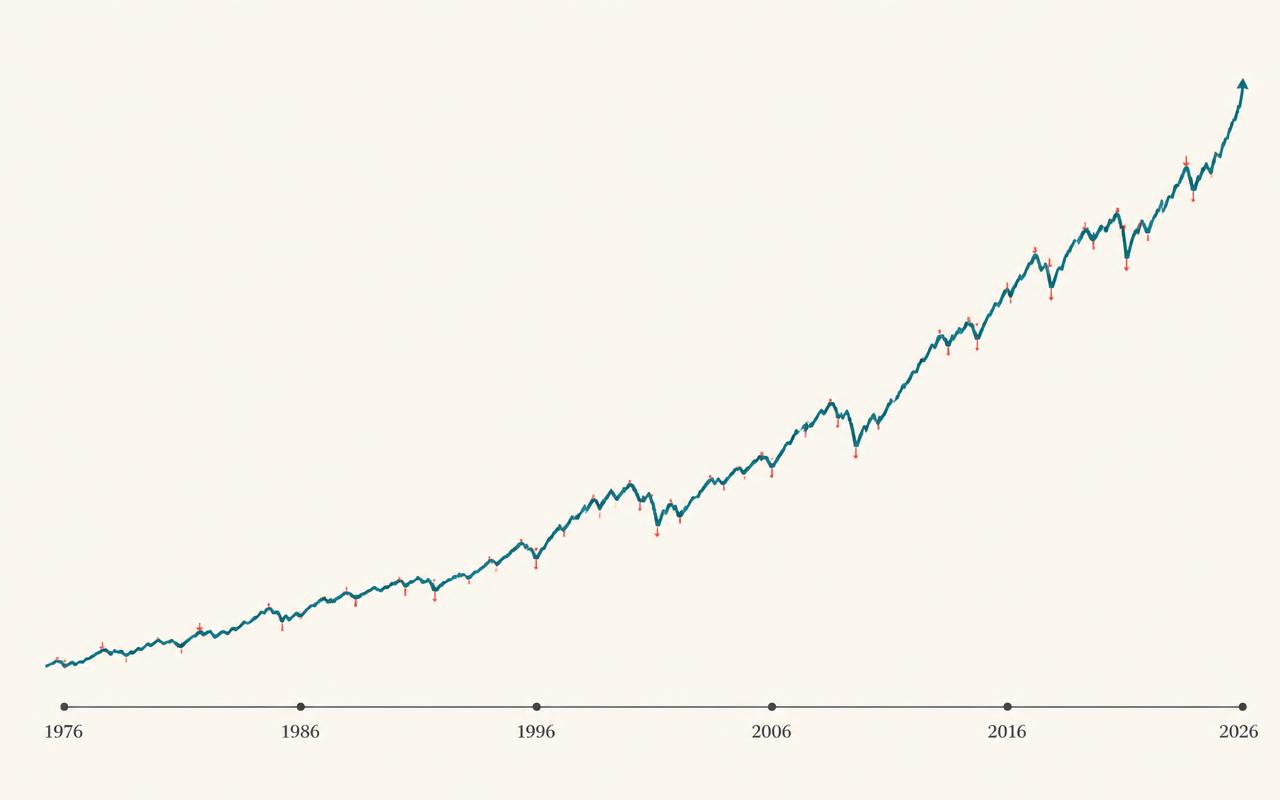
In fifty years of markets, nobody has ever run out of reasons to stay on the sidelines. Inflation, meltdowns, bubbles, elections, wars. The reasons always sound urgent.
A reason in every decade
High inflation and unemployment in 1976. Chernobyl and the Cold War in 1986. The “irrational exuberance” warning in 1996. The housing bubble in 2006. Brexit and a bitter election in 2016. Every one of these years offered a full slate of reasons to stay out of the market. Every one ended with a positive calendar-year return for the S&P 500 Index.
| Year | Reasons not to invest | Stock market return, calendar year | Growth of $10,000, from year in column 1 to 12/31/25 |
|---|---|---|---|
| 1976 | High inflation, high unemployment, China earthquake kills 240,000 | 23.93% | $2,939,582 |
| 1986 | Cold War, Chernobyl meltdown, Iran-Contra affair | 18.67% | $769,374 |
| 1996 | “Irrational exuberance” speech, Federal Reserve rate hikes, Atlanta Olympics bombing | 22.96% | $192,167 |
| 2006 | Housing bubble, subprime loans surging, global credit risks rising | 15.79% | $80,619 |
| 2016 | Trump vs. Clinton, Brexit vote and fallout, Zika virus outbreak | 11.96% | $39,827 |
| 2026 | US and Israel attack Iran, AI bubble fears, contentious midterm election | ??? | ??? |
Calendar-year returns. Growth assumes $10,000 invested on January 1 of the year shown, held through December 31, 2025, with dividends and capital gains reinvested.
The warning that was early by three years
The 1996 entry in that table deserves a closer look, because it shows how costly timing can be even when the caller is eventually proven right.
“Irrational exuberance” was the famous warning given by Federal Reserve Chair Alan Greenspan on December 5, 1996. He was describing the possibility that investors were becoming too optimistic about stock prices, pushing them far above what underlying economic fundamentals could justify. The warning became famous because U.S. stocks continued rising for several years after the 1996 speech. The dot-com boom eventually peaked in March 2000, followed by a major stock-market decline.
An investor who sold in December 1996 was correct about the bubble and still missed roughly three years of exceptional gains before it arrived. Being right early felt identical to being wrong.
What $10,000 became
$10,000 invested on January 1, 1976 and left alone grew to $2,939,582 by the end of 2025. Not because the fifty years were calm. Because the money stayed put through years that were not, including 2022, when the S&P 500 lost more than 18% and still left the long-run record intact.
Notice what that growth required: not a single correct prediction about inflation, elections, wars, or bubbles across five decades. It required only that someone stay invested through all of them.
The goal is a sturdier plan in a chaotic world
2026 already has its own list: conflict in the Gulf, AI bubble fears, a contentious midterm election. Our latest market commentary looks at how those forces are moving markets this week. Some of these worries will prove overblown, and some will prove justified. There is no way to know in advance which, and no reliable way to profit from stepping aside.
The goal, then, is not to find a decade without alarming headlines. There has never been one. The goal is a plan sturdy enough that the next alarming headline does not require a stressed-out decision from you.
If it has been a while since your plan was stress-tested, or if recent headlines have you second-guessing your positioning, talk with our team.
Source: Hartford Funds, “Staying Invested Despite Negative News,” January 2026, with data from Morningstar. Assumes $10,000 invested January 1 of the year shown through December 31, 2025, in the S&P 500 Index with dividends and capital gains reinvested, no taxes or transaction costs. Indices are unmanaged and not available for direct investment. Past performance does not guarantee future results.