

Pay tax once, at a rate you know, and potentially never again on that money. That is the promise of a Roth conversion. Whether it pays off for you comes down to your real numbers, and the 2026 window closes in December.
How a Roth conversion works
A Roth conversion moves money from a Traditional IRA, which is taxed when you withdraw it, into a Roth IRA, where it can grow and come out tax-free in retirement. You pay income tax on the amount you convert in the calendar year you convert it.
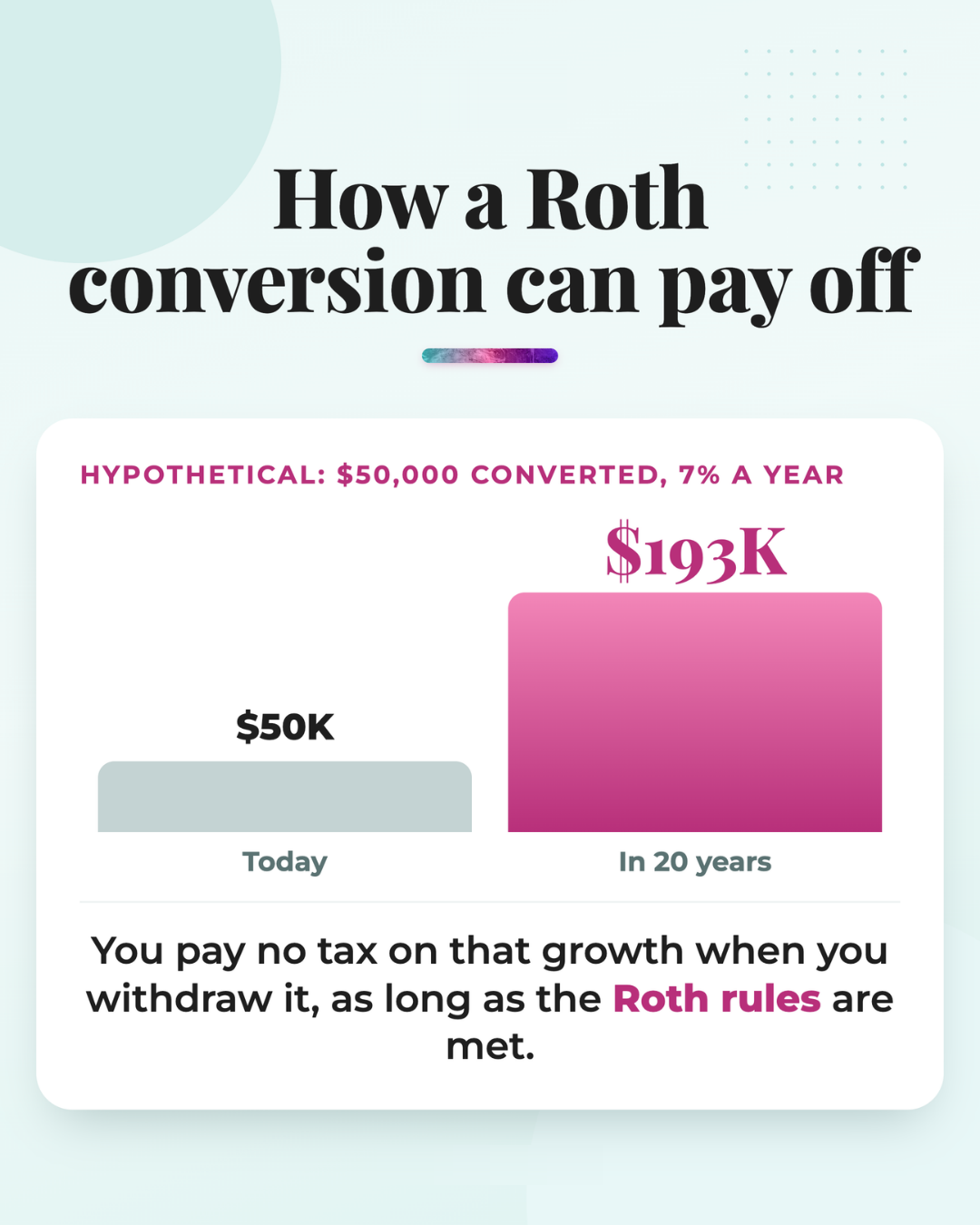
Time does the heavy lifting. In this hypothetical, $50,000 converted today and growing 7% a year becomes roughly $193,000 in 20 years. As long as the Roth rules are met, none of that growth is taxed when you withdraw it.
Three more reasons people convert
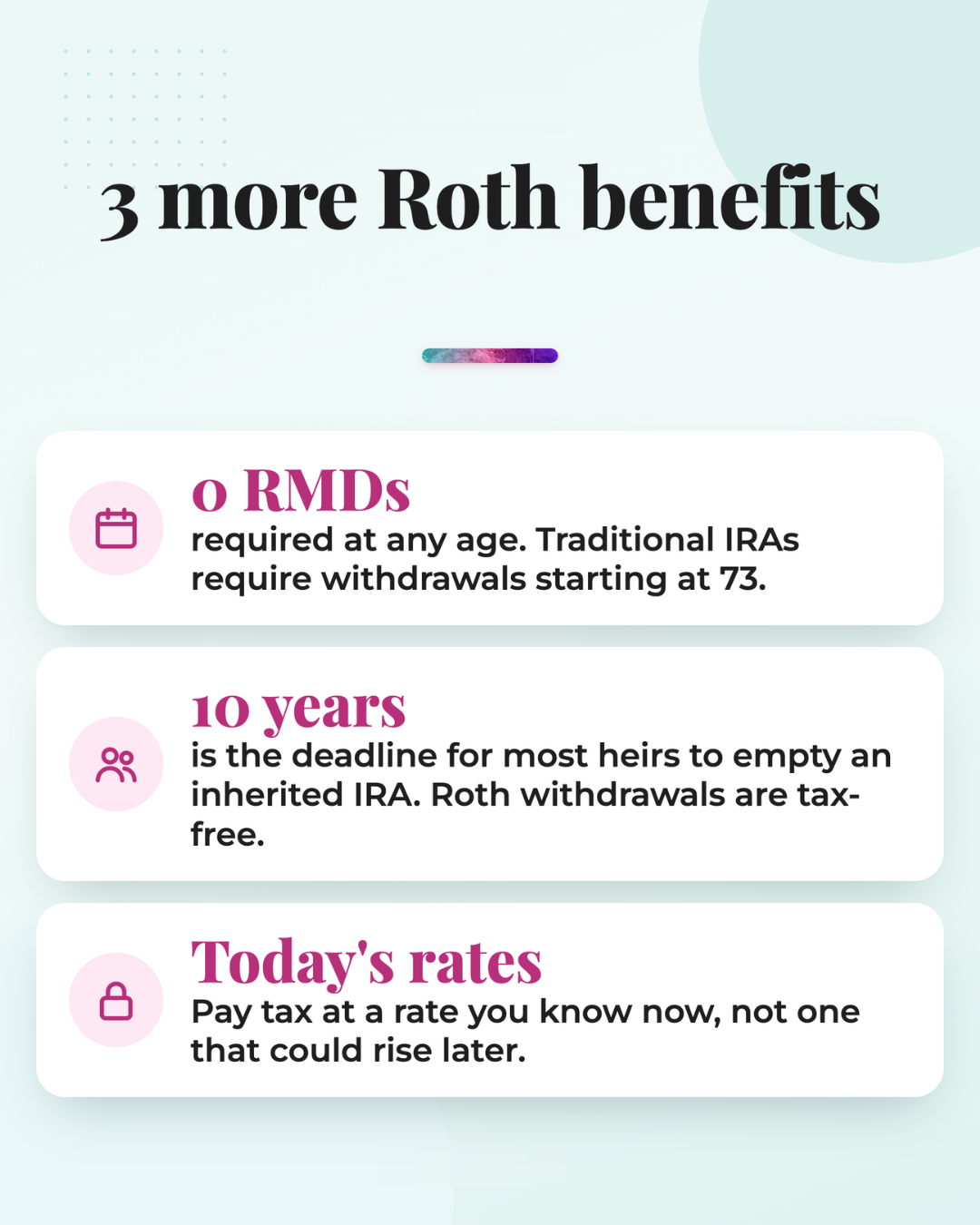
Roth IRAs have no required minimum distributions, while Traditional IRAs generally require withdrawals starting at 73. Most heirs must empty an inherited IRA within 10 years, and Roth withdrawals come out tax-free. And you pay tax at a rate you know now, not one that could rise later.
One sample $250K conversion
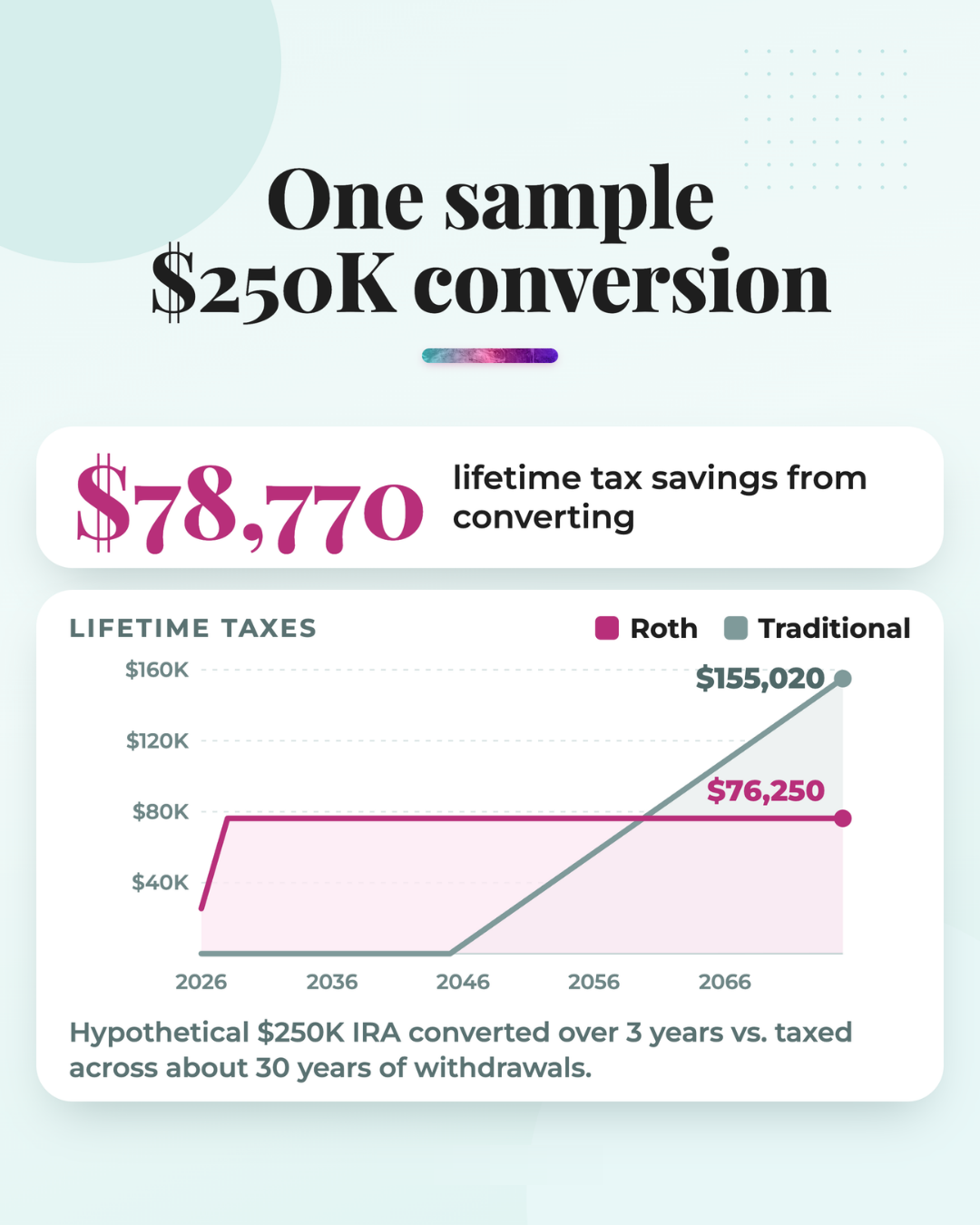
In one hypothetical analysis, converting a $250K Traditional IRA over 3 years cost $76,250 in tax up front, compared with $155,020 over 30 years of retirement, a lifetime savings of $78,770.
What your heirs could keep
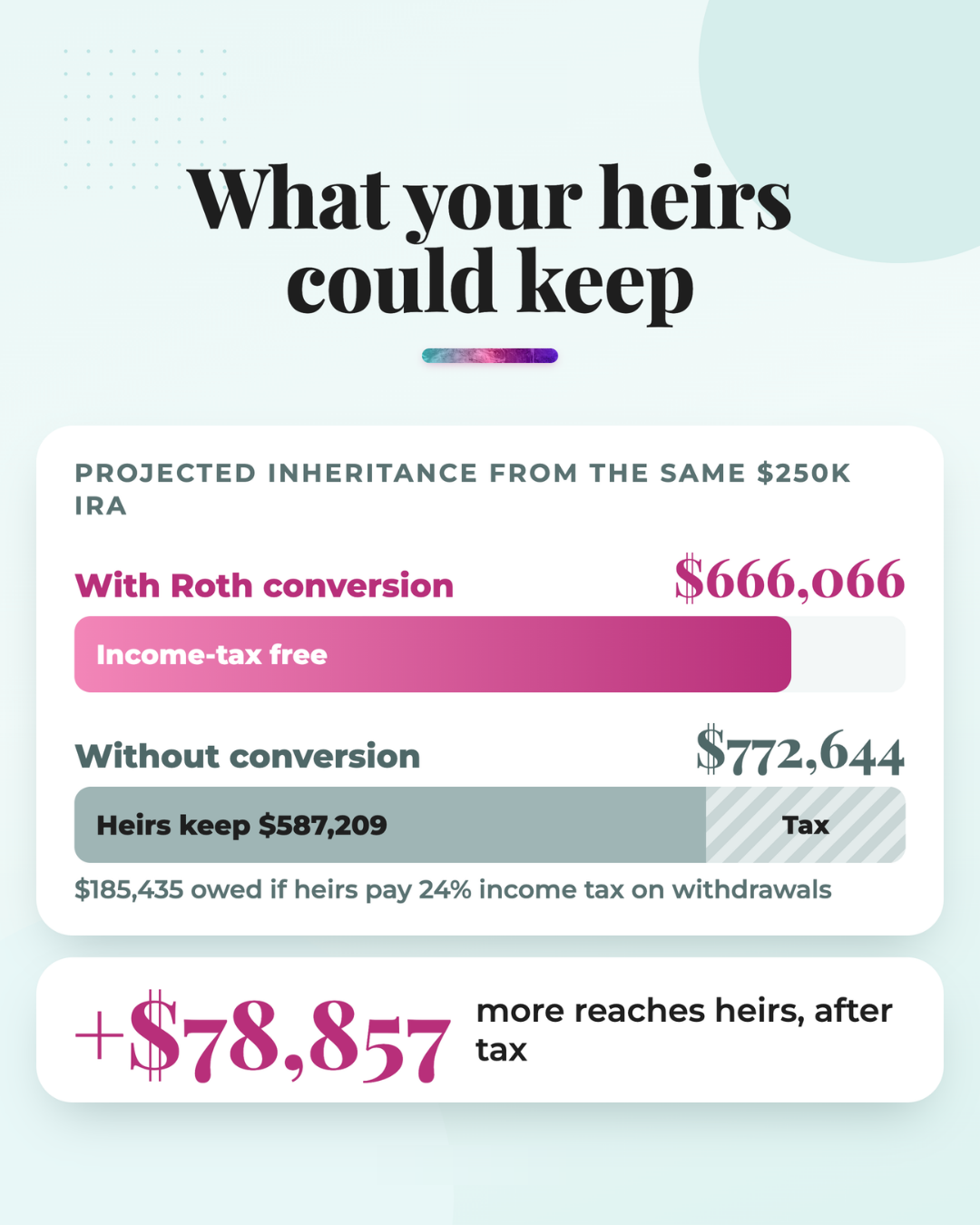
The same conversion also left heirs $666,066 income-tax free, compared with $772,644 that would be taxable had those funds been left entirely within a Traditional IRA. If heirs pay 24% income tax on those withdrawals, they keep $587,209, so roughly $78,857 more reaches them after tax with the conversion.
Find out what a conversion could mean for you
We can calculate the tax impact before retirement, the potential impact during retirement, your total tax breakeven point, and projected inheritance value, based on your real numbers.
Consider converting in a dip to owe less tax
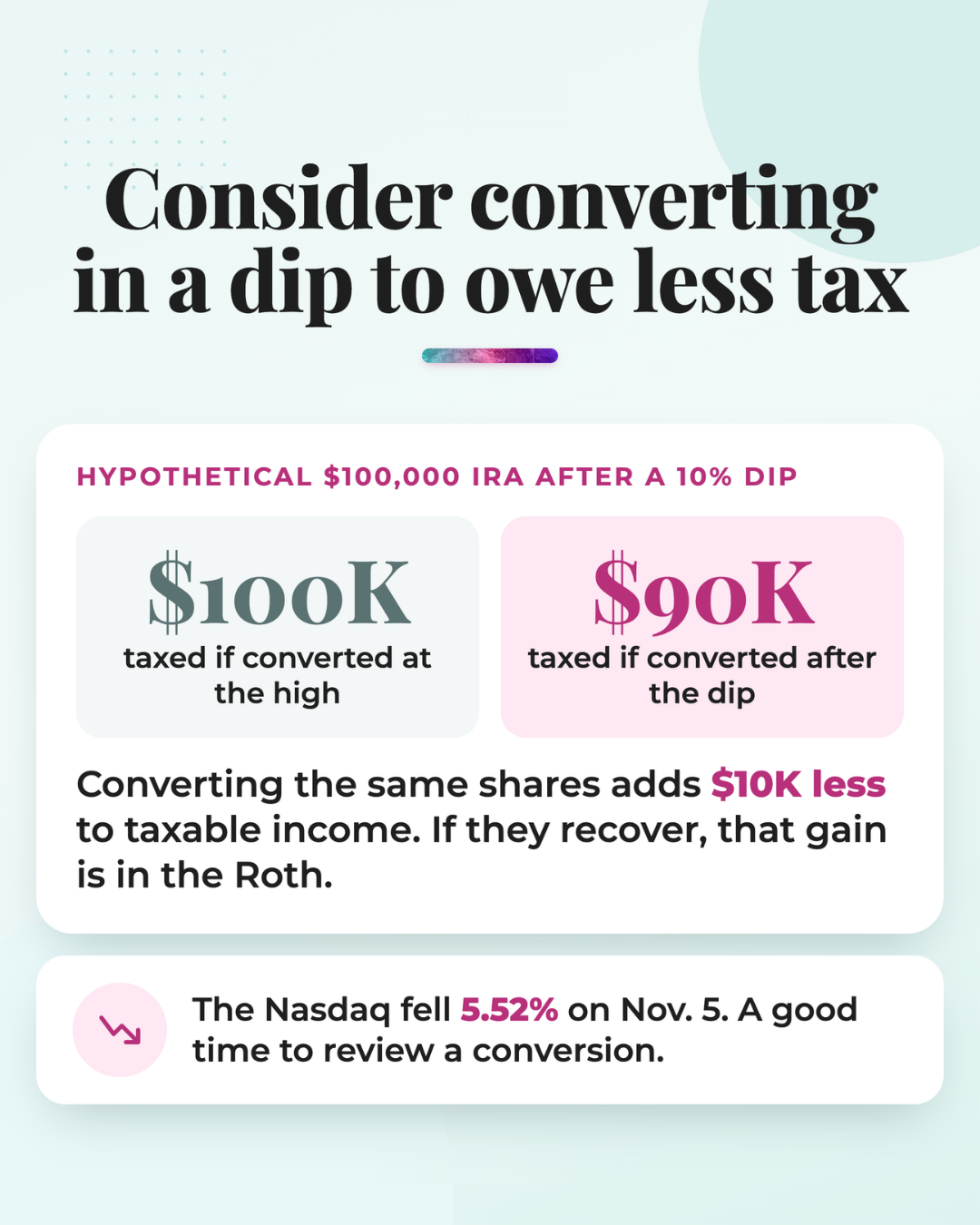
Tax is owed on the value you convert. If a $100,000 IRA dips 10%, converting the same shares adds $10,000 less to taxable income, and if they recover, that gain lands in the Roth. With the Nasdaq down 5.52% on November 5, now is a timely moment to review a conversion.
Inside a deMAURIAC tax analysis
A worthwhile Roth decision is never made from a single chart. Every client receives a personalized tax report built from their own return. Here is a look at a sample report, with personal details removed.
Sample client report · Roth conversion summary
- Tax impact before retirement
- $25,417 a year over 3 years
- Tax impact during retirement
- No additional taxes
- Projected inheritance value
- Income-tax free to beneficiaries
- Conversion details
- $250,000 · 3 years · 4% withdrawals · taxes paid from converted funds
Beyond the conversion itself, the full report reviews your tax snapshot (filing status, income sources, and federal, capital gains, and state brackets), deductions and charitable giving, your safe harbor payment target, income thresholds that affect credits and deductions, Medicare premium brackets, dividends and interest, and how to move your portfolio toward its target in a tax-aware way. It is the kind of thorough, numbers-first view that turns a guess into a decision.
The 2026 window closes in December
The IRS deadline is December 31, but custodians typically stop processing conversions in mid-December. A thoughtful analysis takes a little time, so starting now keeps every option open.
See your numbers before year-end
Your breakeven, lifetime savings, and legacy value, calculated from your return.
Pair it with other year-end moves
Loss harvesting, contributions, and giving all share the December deadline.
Book your tax-smart analysis at deMAURIAC.com and see the options appropriate for your situation before year-end. Connect with us to schedule a visit.
Sources: Hypothetical tax planning software example, 2026 ($250K traditional IRA converted over 3 years, taxes paid from converted funds, 4% withdrawals, 3% inflation, life expectancy 90; heirs’ after-tax value assumes a 24% income tax rate on inherited traditional IRA withdrawals); IRS Rev. Proc. 2025-32; SECURE 2.0 Act (RMD age 73; 10-year rule for most non-spouse heirs); Nasdaq Composite close, Nov. 5, 2026. All examples are hypothetical, not a projection and not a guarantee. Conversions are taxable income; five-year rules and Medicare premium effects apply. Not tax advice.